By Bryan Rogala
If you’re interested in adding a camper to your pickup, chances are pretty good you’ve seen or heard the term “payload” come up in your research. There’s a good reason for that. It’s something that’s easily misunderstood and can have an impact on your truck’s drivability, reliability, and your safety while traveling.
Let’s dive into payload, along with some other key information you’ll need to keep in mind about your truck before adding a camper.
Truck terms, defined
There’s a lot to know about loading up your truck, but before we dive into the nitty-gritty, let’s talk about what payload is not:
- The amount of weight you can put in the bed of your truck (this is a very common misconception)
- Towing capacity (this is how much weight your vehicle can safely tow, or pull, not carry)
Here are some of the most important terms to know as a pickup owner:
- Curb Weight
- This is the weight of your empty truck as it’s rolled off the dealer lot, with a full tank of gas.
- Gross Vehicle Weight Rating (GVWR)
- This is the maximum amount your truck is rated to weigh when it’s fully loaded with passengers, cargo, and gear, as determined by the manufacturer.
- Payload
- This is the total amount of weight (including occupants, cargo, fluids, etc.) your truck is rated to carry per the manufacturer. That includes what goes inside the cab and what’s put in the bed.
- Payload can be calculated by subtracting curb weight from gross vehicle weight: GVW - Curb Weight = Payload
- Gross Combined Weight Rating (GCWR)
- This is the total amount your truck and trailer can weigh together. Towing capacity is typically GCWR - GVWR*
- Gross Axle Weight Rating (GAWR)
- This is the total amount of weight your truck’s axles are rated to carry. There are separate ratings for the front and rear axles.
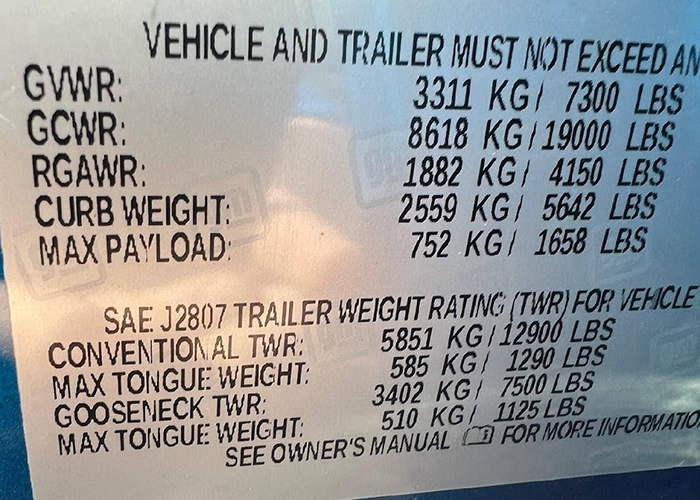
General Motors’ trucks have some of the better payload and weight rating stickers out there (Source: https://www.silveradosierra.com/threads/post-your-payload-stickers.760461/)
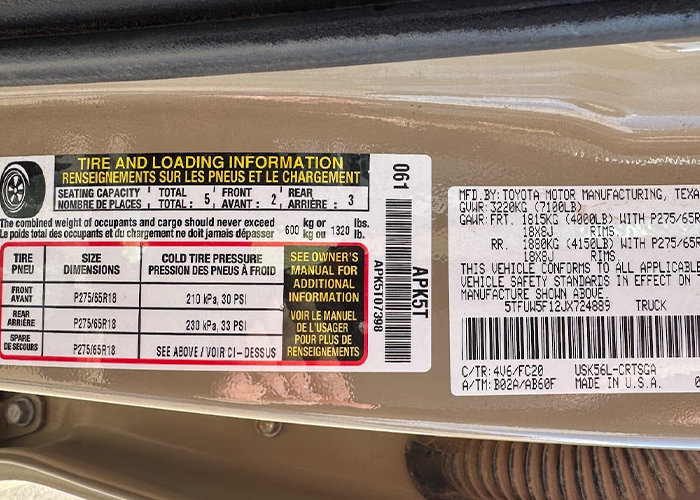
All of these numbers can be found in your owner’s manual and on stickers in the driver’s side door jamb. One important note is that these numbers are specific to each individual truck (not just the make and model). That’s because payload and weight ratings can change significantly based on what options the truck has. A barebones, two-wheel drive work truck will weigh a lot less than a four-wheel drive luxury trim truck with all the bells and whistles, and therefore have a higher payload capacity (see examples here).
This is all made even more confusing by the fact that auto manufacturers typically market their pickups by advertising the maximum payload and towing capacities possible for a given model, despite the fact that those numbers are only achievable with a bare-bones, two-wheel drive trim.
The best way to determine how much payload capacity your truck has is to take it to a certified scale, like a CAT scale found at many gas stations, and weigh it. Subtract that weight from the GVWR, and you’ve got your real-world payload capacity.
The point of my telling you all of this is to highlight the fact that your truck likely has a lower payload rating than you think it does.
Let’s take my own truck, a 2018 Toyota Tundra, as an example. In 2018, the Tundra was available as a Double Cab with a 6.5ft bed or 8ft bed, or a Crew Max with a 5.5ft bed. You could also choose between a 4.6L V8 or a larger, 5.7L V8, 2WD or 4WD, a 26 or 38 gallon gas tank, and a variety of trim levels. Here’s Toyota’s footnote about payload in the 2018 Tundra brochure:
44. “Payload capacity” is the calculation of GVWR minus curb weight and should be used for comparison purposes only. Do not exceed any Weight Ratings and follow all instructions in your Owner’s Manual. The maximum you can haul (payload) depends on base curb weight plus the total weight of any cargo, occupants, and added vehicle equipment. “Added vehicle equipment” includes additional standard/optional equipment and accessories added by the manufacturer, dealers, and/or vehicle owners. The only way to be certain of your vehicle’s exact curb weight is to weigh your vehicle without passengers or cargo.
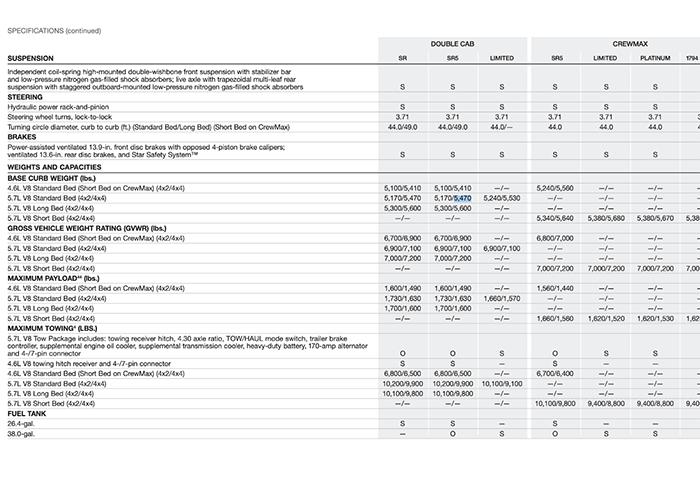
(source: https://dealerinspire-brochure.s3.amazonaws.com/1534.pdf)
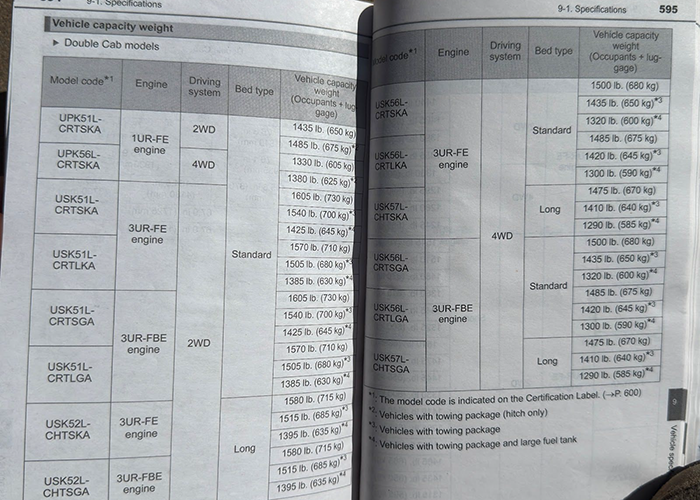
In this photo of my owner’s manual, you can see payload and tow ratings for various configurations
My particular Tundra is an SR5 with the 5.7L V8, 4WD, and the 38-gallon gas tank. Those last three options reduce my truck’s payload to 1,320 lbs, compared to Toyota’s advertised 1,730 lbs of maximum payload.
What happens if I go over the payload?
Simply put, all of these ratings are what the manufacturer and the engineers who designed the vehicle and its components determine to be the maximum amount of weight your truck can safely and legally carry. In other words, you shouldn’t exceed any of those limits if you want a vehicle that drives and stops the way it is supposed to.
There are also legal implications for exceeding your vehicle’s payload capacity, which can vary by state and circumstance. While fines and penalties are more commonly enforced for commercial vehicles, you can still be cited for being overloaded (especially if you are in an accident), and your insurance may not cover you.
It’s worth noting that exceeding your GVWR by a small amount is not likely to cause your truck to spontaneously combust. That said, these weight ratings exist for a reason, and it’s a good idea to stay within them.
The Overlanding Conundrum + Going Over Payload
Ever noticed when you try to type the word “overlanding” in a text message, it often autocorrects to “overloading”? It’s a funny coincidence, but there’s some serious irony in that. As overlanding has become more and more popular in recent years, it’s seemingly become somewhat of a fashion statement or flex to bolt as many accessories as possible to a rig.
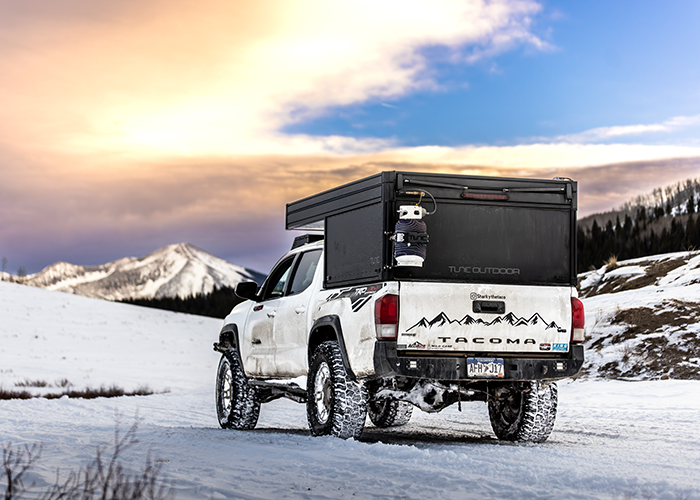
It’s also not uncommon to see smaller pickups, like the Toyota Tacoma, carrying heavy truck campers. Even traditional lightweight, slide-in campers like a Four Wheel Campers Fleet can quickly push a truck over its GVWR. FWC lists the dry weight (meaning the weight of the camper before any gear, water, propane, etc. has been added) of a base model Fleet at 1050lbs. A 2026, 4WD Tacoma has a payload rating of between 1230-1680lbs, which would leave just 180lbs - 630lbs of remaining payload after the camper is installed.
Add two to three passengers, a dog, food, camping gear, and a mountain bike or two, and it’s easy to see how you can very quickly end up with an overloaded truck.
A common question is whether you can increase your vehicle’s payload through modifications. The short answer is no. In the US, the only legal way to increase payload capacity is to remove weight from the vehicle (for example, removing the rear seats). While upgrades like suspension kits with higher spring rates, big brake kits, and tires with a higher load rating can improve how a truck handles weight, they won’t legally increase your vehicle’s GVWR.
I highly recommend watching this video for a better understanding of how all this works: https://www.youtube.com/watch?v=v1dLzJeHh-g
I’ve also written about this topic in more depth for Outside Magazine here.
How Much Does a Tune weigh?
It may seem obvious, but the real answer to the truck camper payload conundrum is simply to pack less stuff in your truck and to choose a lightweight camper from the start.
This is where the Tune M1 and Tune M1L really shine. Remember that slide-in camper with a base weight of 1050lbs mentioned above? Well, by comparison, an M1 has a starting weight between 400-500lbs and an M1L starts at 350-400lbs.
A Tune M1 installed on a 2026, 4WD Tacoma would leave you with 830-1240lbs of remaining payload—a substantial difference that translates directly to better handling, safety, and peace of mind.
More reading on payload for those who want to nerd out:
https://expeditionportal.com/is-your-overland-vehicle-overweight-here-is-a-possible-solution/