Truck Campers Explained: Slide-in, Wedge, Full Pop-up, and Every Style In Between
A truck camper is a camping shelter designed to mount in the bed of your truck and gives you an elevated, weather-protected sleeping and living space. Compared with towable trailers, a slide-in truck camper or pop-up topper camper keeps your rig’s turning radius, departure angle, and trail clearance close to stock specifications. That is why pop-up truck campers are a staple of overlanding and backcountry travel.
Truck campers come in several styles. Pop-up truck campers cut their travel height by lowering the roof, and not all are built the same. The roof mechanism, wall construction, and geometry affect the weight, interior volume, aerodynamics, and setup time. Slide-in campers are another option, available in both pop-up and rigid designs.
Choosing the right truck camper depends on your truck's payload capacity, the amount of standing and sleeping space you need, and how you plan to travel. This guide explains the different types of truck campers, compares their advantages and trade-offs, and helps you decide which style fits your adventures.

Types of Truck Campers
1. Wedge Pop-Up Campers
The roof hinges at the front (toward the cab of the vehicle) and lifts from the rear, forming a wedge profile.
- Deployment: Often under a minute, usually utilizing gas struts or a manual lift
- Standing Room: Concentrated at the rear, where the raised portion of the wedge exists. Headroom tapers toward the front.
- Weight: Typically the lightest style because of the simplified lifting mechanism and includes fewer building materials. Starting weights for mid-size truck models are around 330lbs
- Stowed Profile: Low. Some models have a sloped profile that can reduce wind drag compared to boxier designs. Many wedge campers do not overhang the cab, creating a more streamlined vehicle.
- Best for: Trips where you only need to be inside to sleep, smaller trucks, and drivers who prioritize trail performance and fuel economy.
Front-Lift Wedge Variant Pop-Ups: Some wedge pop-ups are designed with the hinge at the rear of the camper, and the front is raised - the reverse of a standard wedge. The trade-off with this design is that users have less standing room over the truck bed, since more headroom is created over the cab of the vehicle. This design also changes how the camper’s mass shifts when raised.
2. Full Pop-Up (Vertical Lift, Four-Sided) Campers
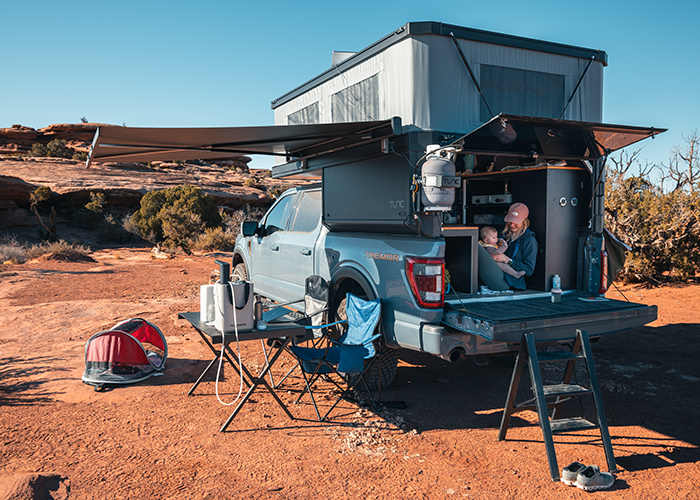
The entire roof rises parallel to the base on all four sides, creating a uniform interior height. The Tune M1 and Tune M1L are examples of this style.
- Deployment: Usually only a couple of minutes, using gas struts that lift one end at a time or a lift system that raises all four sides at once.
- Standing Room: Full standing height across the whole camper’s footprint. Tune campers have 6’4” of standing room in a mid-size truck and 6’10” in a full-size truck. Plus, the WingWall design of the Tune M1 model provides a roomy interior living space.
- Weight: Somewhat heavier because of the four-sided design and added interior volume, but still within payload capacity of properly configured mid-size and full-size trucks. The Tune M1L weight depends on the configuration and the truck it’s built for, but builds start at approximately 400lbs.
- Stowed Profile: Typically a flat, boxy roofline with a slightly larger frontal area than a wedge. Usually hangs over the cab of the vehicle somewhat. Wind drag is a bit higher than that of a wedge pop-up camper, though a low stowed height keeps it close to cab height.
- Best for: Families and couples, extended trips, bad weather, cooking and changing indoors, interior living space, and flexible interior layouts.
The Tune M1 and Tune M1L are full pop-up campers that offer some of the most interior living space in the industry. The Tune M1 offers approximately 6'4" of headroom and 200 ft³ of interior volume (65% more than the leading wedge camper). For this reason, Tune campers are an excellent choice for those who prefer a little more living space, like families, couples, and those who go for extended trips and want space to hang out inside the camper. Additionally, there are so many configuration options that you can truly make your Tune camper exactly what you need.

Want More Room Without a Heavy Slide-In?
The Tune M1 combines a full pop-up roof with a WingWall™ design to create extra interior space while preserving the everyday utility of your truck bed. See how its dimensions, sleeping layout, and modular features compare to other lightweight truck campers.
3. Hard vs. Soft-Sided Full Pop-ups
Within the Full Pop-up Truck Camper category, there are soft-sided and hard-sided styles. The Tune M1 and Tune M1L are examples of the soft-sided style. Each style has its own pros and cons:
- Hard-side (rigid panel) walls: Better insulation, durability, and noise reduction, and generally better in cold, wind, and heavy rain. Composite or aluminum panels add weight and cost. Typically more complex to lift and lower, since the walls need to be folded in or overlap with the lower half (telescoping hard-sided pop-up campers).
- Soft-side (fabric/canvas) walls: Lighter, and they often allow more ventilation and lower stowed height. Have a lower insulation value, which can allow for more condensation. Long-term fabric care may require more attention. Insulation kits are usually available to help with regulating temperature - like the Tune Insulation Pack.

4. Telescoping Hard-Sided Full Pop-ups
These have a rigid roof and walls that lower into a compact travel position by utilizing hydraulic lifts. They are designed so that the upper half of the camper lowers over the lower half, with the walls overlapping in the stowed position. This combination enables hard-sided durability with a lower stowed height. However, they are usually much heavier and are mechanically more complex than other types of pop-up campers.
5. Slide-in Truck Campers
A slide-in truck camper sits in the bed of your pickup truck and is secured to the truck with specialized tie-downs. You can remove it with jacks or a lift system, so you can use the truck for everyday driving without the camper installed. The term ‘slide-in’ refers to the mounting style, and slide-in truck campers come in all the roof types we covered above: full pop-up, wedge, and telescoping, as well as fully rigid walls that do not collapse. These campers are typically fully self-contained, including built-in beds, cabinets, sinks, and cooktops. Some even have built-in bathrooms.
Many slide-in campers are not pop-ups at all, but rather fully rigid campers that are always in their usable state. This means that they tend to offer more interior living space and amenities, but they are also larger, heavier, and lack the ability to customize the interior for your specific use.
- Deployment: Depends on roof type. Wedge slide-ins typically deploy in under a minute, and full pop-up models usually take 1-3 minutes. Keep in mind that loading the camper into the truck is a separate step that can take 15-30 minutes with jacks and tie-downs. With rigid slide-in campers, there is typically no setup required; you just get to camp and start camping.
- Standing Room: Also depends on style. Wedge slide-in campers have more standing room at the raised end, while full pop-ups and telescoping designs offer full standing height across the whole camper. In addition, rigid slide-ins tend to offer the most comfortable living areas with fully built-out interiors.
- Stowed Profile: Varies widely by model and depends on how large a slide-in truck camper you choose. Some slide-in truck campers with pop-tops are very low profile and barely affect the truck's footprint. Other rigid slide-in truck campers are very large, especially those with a cab-over bed and a living space that extends beyond the truck bumper.
- Weight: Generally much heavier than any other truck camper described in this blog, but can range widely depending on the type. Slide-in truck campers with pop-tops are the lightest of this category, while rigid slide-ins weigh the most.
- Best for: Drivers who want a fully built-out camper with all the amenities inside (cabinets, sink, cooktop, dinette). Drivers who want to take their camper off of their truck seasonally prefer this type of truck camper. Keep in mind, Tune campers can be removed by using the specially designed jack stands. Rigid slide-ins suit anyone who prefers the most interior living space available without towing a travel trailer.
Comparing Technical Features of Different Truck Campers
Lift Mechanisms
The different types of lifting mechanisms make a significant difference in the experience you have when setting up and taking down your camper.
- Gas struts: Pressurized struts assist the lift. Simple and light; strut wear over time.
- Manual crank/cable: Hand-cranked pulley or screw system. Low electrical dependence; slower.
- Electric/hydraulic actuators: Motorized lift. Fast and effortless; requires power and adds weight.
- Scissor or linkage: Mechanical linkage keeps the roof level. Even lift; more moving parts.
Camper Weight, Payload Capacity & Axle Ratings
Your truck's payload is listed on the door-jamb sticker. Vehicle manufacturers recommend that you do not go over your vehicle’s payload. To determine how close you are to your payload, add the camper's wet weight (with water, gear, batteries, and propane), passengers, and any accessories that you carry while camping. Payload is a vehicle-wide limit, but rear axle load matters too. Weight sitting behind the axle also affects steering feel and braking, so keep that in mind when comparing campers.
Learn How to Calculate Your Truck’s Payload
Aerodynamics and Fuel Economy
Stowed height, the design of the front of the camper, and roof shape all affect wind drag while driving. Wedge profiles tend to shed wind more easily due to their tapered roof. The boxier the camper is, the more wind resistance it has, negatively impacting your truck’s fuel economy.
Center of Gravity
A lower, more forward CG improves handling on trails and in crosswinds. Lighter, low-profile campers are advantageous off-road, while taller designs may need suspension upgrades in order to handle the way the camper’s weight affects your truck’s steering and handling.
Interior Volume
Along with weight, this feature is one of the most important to consider in pop-up campers. Pop-up campers vary widely in interior volume, depending on their design. Usually, there is a trade-off between a camper's weight and slim profile and its interior volume. The larger, roomier campers tend to weigh more and have a boxier profile.
Insulation and Condensation
Hard-side panels, thermal liners, vents, and fan placement all affect comfort in cold or humid conditions. Many soft-sided campers are designed to accommodate insulation accessories that help prevent heat loss and reduce condensation. For example, the Tune Insulation Pack is easy to install and can stay in the camper year-round to help regulate temperature. Plus, it can stay installed while the camper is closed, making it the easiest way to add warmth to the soft-sided Tune camper. Hard-sided pop-up truck campers and rigid slide-in truck campers have the best insulating properties, making them more resistant to condensation in cold temperatures, and hard-sided campers tend to be much quieter inside.
Bed Size and Accessibility
Each truck camper design has a slightly different bed size and orientation. Most wedge pop-up campers are oriented north-south, meaning you sleep parallel to the vehicle’s orientation. However, because they are narrow, achieving a double- or queen-size width requires a full, wall-to-wall platform. This means you have to remove a bed panel to access the lower portion of your truck bed, which can be a challenge for midnight bathroom visits. Some taller people may feel a bit claustrophobic in a wedge pop-up camper, due to the narrow end feeling cramped.
In contrast, full pop-up campers typically overhang the cab of the vehicle, creating a separate space where the bed exists. This gives you full access to your truck bed with the bed always assembled. Full pop-up campers vary between north-south and east-west sleeping configurations. This means you will need to choose the design that best fits you and your camping style. Many campers dislike sleeping east-west because, for couples, one partner has to climb over the other to get out of bed.
The Tune design team has provided several configuration options to suit your preferred sleeping situation. All Tune camper models come standard with an approximate queen-size bed platform, measuring 60” wide x 72” long, oriented east-west (varies for some smaller trucks like the Rivian and Maverick). For those who are a little taller or want more room, a king bed extension is available for the Tune M1, creating a north-south bed platform measuring 72” wide x 80” long in mid-size trucks and 78” wide x 80” long in full-size trucks.
Integrated Power, Water and Cooking Systems
Some truck campers come with built-in utilities, such as solar systems and batteries, a heater, a fan, and water or cooking systems. Many slide-in campers come with these amenities built into the camper’s structure. Consider how this affects the camper's overall design and weight versus the practicality and usability of these systems. Some pop-up campers are designed to be very basic, including just the essentials, while others are designed to be a home on wheels with all of the utilities and systems of a traditional RV. The best choice for you depends on how you intend to use your camper and the level of comfort you prefer. Just remember: there is usually a trade-off between comfort and amenities, and the weight and maneuverability of the camper.
Customizability
Customization varies across truck camper styles. Simpler pop-up campers are essentially toppers with a bed, letting you customize your truck bed to suit your needs. For example, Tune T-track is built in throughout the Tune M1 and M1L campers, letting you add gear hooks, MOLLE panels, and other accessories where you need them most. At the other end of the spectrum, some truck campers have many built-in accessories and systems that limit your ability to customize the design and how you use it. Tune M1 and M1L campers are highly customizable and can accommodate a wide range of build-outs, depending on your needs. Many of our customization options are modular, so you can remove them when you need to use your truck as a truck. The modular bench is a great choice for keeping gear organized and adding a little interior seating.
Get Help Choosing a Camper for Your Truck
Which Truck Camper Style is Right for You?
- Choose a wedge if you mostly just sleep in the camper, drive a smaller truck, or want the lightest, quickest-setup option.
- Choose a full pop-up if you spend real time inside for cooking, changing, or waiting out weather, or if you take longer trips.
- Choose hard-side construction for cold, wet, or windy climates and year-round use.
- Choose soft-side construction if you prioritize low weight and ventilation.
- Choose a pop-top slide-in if you prefer the built-ins, but want to save a little weight and height.
- Choose a rigid slide-in if you want the largest living space available and built-in amenities.
Truck Campers are an Upgrade From Tent Camping
It’s undeniable that all truck campers are a major upgrade over tent camping, and the right choice depends on how much interior space you need versus how much weight and complexity you're willing to carry.

Find the Right Truck Camper for Your Adventures
Whether you prioritize a lightweight setup for narrow trails or a more spacious camper for longer trips, Tune Outdoor has two full pop-up models to consider. Compare the M1 and M1L, select your truck, and explore the configuration that fits your camping style.