Can the Tune Outdoor Truck Camper Handle Rough Trails?
The best camper for off-roading isn’t the one with the longest list of features or the latest and greatest tech. It’s the one that holds up when the trail gets ugly: light enough to keep the truck nimble, low and tight to keep the vehicle’s center of gravity in check, and built from materials that can take a beating. Many off-roaders have learned this the hard way and ended up with a Tune Outdoor truck camper because of it. This blog explains why Tune truck campers are the best campers for off-roading, with real-world examples of Tune owners who have pushed them to the limit and come out impressed.
What Makes Campers Better for Off-Road Trails?
Off-road campers are a different category of camper. A camper that’s designed for a paved campground can be a liability on a rutted shelf road. When driving difficult off-road trails, three aspects of a camper get amplified: weight, height, and vibration. Every extra pound puts more load on your truck’s suspension. Every inch of height makes it easier to hit your rig’s tipping point. Hours of washboard roads and bumpy rock-crawling will loosen every weak fastener and latch.
Weight: The Number That Determines Everything
The biggest limiting factor to off-roading with a truck camper is your vehicle’s payload. The Tune M1 and Tune M1L campers are designed specifically for mid-size and full-size trucks without consuming too much of the vehicle’s payload, so you can stay within your limits and still bring all your gear.
A few rules of thumb when considering your off-road truck camper:
- Stay well under your payload, not right at it. Off-road, dynamic loads (bouncing, dropping into ruts) exceed the static weight sitting in the bed.
- Account for everything else on the truck: bumpers, winch, skid plates, roof rack, tires, and passengers all eat into payload.
- Lighter builds keep braking, steering, and fuel economy closer to normal and put less stress on axles and suspension.
Typical weight ranges for the Tune M1 and Tune M1L largely depend on the build configuration and which truck it’s built for. The Tune M1L camper has a base weight of around 350 lbs, while the Tune M1 typically starts at around 400 lbs.
Center of Gravity: Low, Forward, and Tight
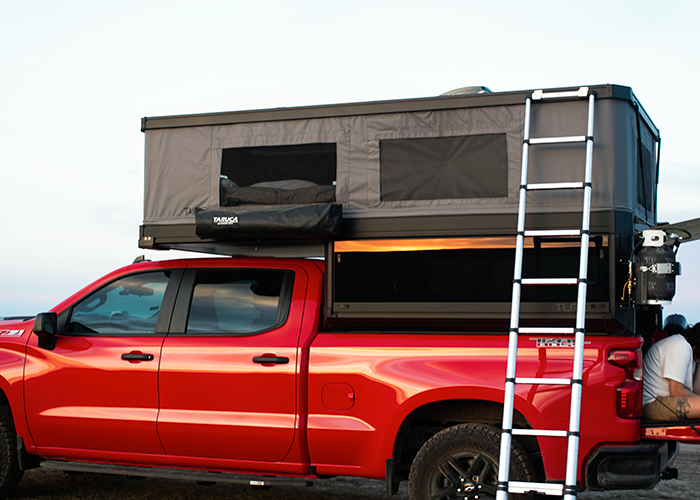
Center of gravity makes the difference between a confident, comfortable ride and a white-knuckle, off-camber situation. The lower the weight of your camper sits, the more stable your rig will feel on tippy trails. Pop-up camper designs like the Tune M1 and Tune M1L are engineered to keep the overall vehicle height and center of gravity as low as possible while driving. That’s a big reason why they’re so popular with off-roaders.
When packing your gear, it’s important to be aware of how you place your weight. Heavy items like batteries, water tanks, and electric fridges should be mounted close to the truck bed floor and toward the cab, not up high or hanging past the rear axle.
Watch for rear overhang. Any weight, such as a bike rack, that overhangs the rear bumper can act like a lever on rear approach and departure angles and can cause more swing on uneven terrain.
Materials and Construction: Built to Last
There is nothing worse than finishing a tough trail and opening the back of your rig to find parts and gear everywhere. Off-road trails create a vibration test that never ends, and only the best campers survive. Tune campers are specifically designed and engineered to handle the most rigorous trails.
- Aluminum framing: made of lightweight aluminum extrusions with composite corner brackets. The extrusions interlock with bolts instead of welding, making the design modular and field-repairable if a component is damaged. LED light housing, T-tracks, and window hinges all live inside a single extrusion. That means fewer separate pieces to rattle loose.
- FRP roof: FRP panels form the roof and sleeping platform, with a honeycomb fiberglass design built to withstand hail, insulate, and support 500 lbs when the camper is closed. It’s incredibly lightweight and strong.
- Fasteners and hinges: The built-in 40-series T-track accepts M8 hammer nuts, so you can mount accessories that stay in place. Hinges for the aluminum awning panels are integrated into the extrusions and are designed to mitigate dust intrusion and rattling.
Real-World Proof: Learning From Rigs That Get Pushed to the Limit
Seeing how far others can push the Tune Outdoor truck campers in off-road situations is the best way to evaluate the camper’s durability.
Sharky Taco on Hell’s Revenge
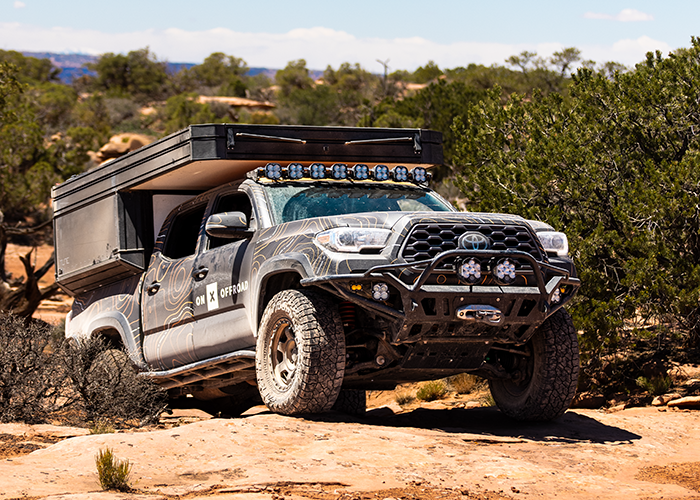
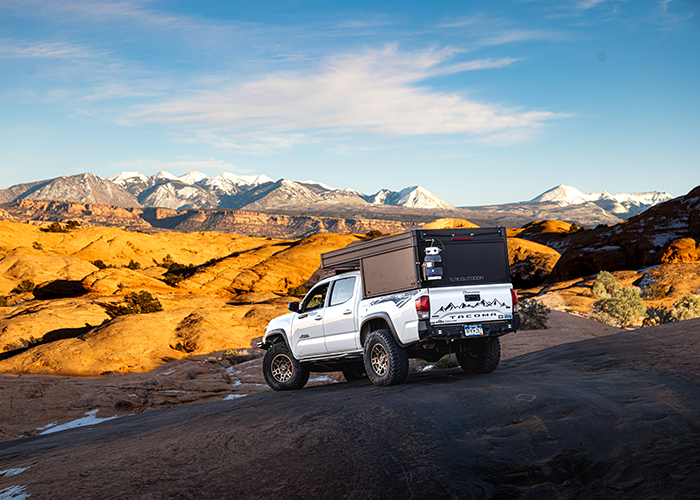
Hell's Revenge in Moab, Utah, is a technical trail only recommended for experienced drivers because of its hazardous terrain. Max (@MaxisStoked) took his Tacoma x Tune M1L truck camper on the trail and pushed the rig to its limits.
“Tune did an incredible job with the construction of the M1L. I feel fully comfortable wheeling hard- slamming the truck on rocks, jumping the truck, and even hitting the Tune up against trees. It’s built strong and rugged. If you are looking for the best balance of capability and comfort, I believe the Tune M1L simply cannot be topped.”
- Max, SharkytheTaco
Drifter Journey in Baja, Mexico
Baja, Mexico, provides no shortage of bumpy, washboard roads. Even the paved roads are full of potholes and random obstacles in most places. Greg and Jess (@DrifterJourney) test their Tune M1 on a regular basis, sharing some of their favorite beaches and spearfishing spots.
“Baja is the ultimate proving ground for off-road vehicles. Not because of hard trails or technical obstacles, but because the condition of the roads is so variable from one spot to the next. We’ve had trips where even the main highway had huge potholes, dips, and washouts with rough bypasses. Since there are so few roads to travel the peninsula, most of them are very worn out. If the Tune camper can handle the sustained vibration and jarring, it can handle anything!”
- Jess & Greg, Drifter Journey
Trails That Provide the Ultimate Test
Want to find out how your camper really performs? These are well-known routes that reward a capable rig. Use onX Offroad to check current conditions, difficulty ratings, and land-access details before you go.
- Rubicon Trail (California): A classic. Long, rocky, demanding, and a serious test of clearance and suspension.
- Black Bear Pass (Colorado): A high-altitude, exposed shelf road with tight switchbacks. Center of gravity and rig width matter here.
- Imogene Pass (Colorado): A popular high-alpine route with stunning views and a mix of rocky and loose terrain.
- Moab, Utah (Poison Spider Mesa, Hell's Revenge): World-famous. Slickrock and steep ledges that test articulation and approach and departure angles.
- White Rim Road (Canyonlands, Utah): A long, remote route that's as much a test of self-sufficiency as of the rig.