If you're considering a truck camper, one of the first questions is: How much will it affect my gas mileage?
The answer depends on more than just the weight of the camper. Adding a camper changes both the weight and aerodynamics of your truck, and those two factors affect fuel economy differently.
Your truck, camper configuration, driving speed, terrain, wind, tires, engine, and payload all play a role. Because of that, there isn't one MPG number that applies to every truck and camper combination.
Weight Matters
One of the biggest factors affecting fuel economy is weight.
Tune pop-top truck campers start at just 350 lbs, making them significantly lighter than many traditional hard-sided truck campers. Less weight means less energy is required to accelerate and move the vehicle.
Your total payload matters, too. Water, gear, bikes, recovery equipment, and interior components all add weight. If maximizing fuel economy is a priority, keeping your build and payload intentional can help minimize the impact.
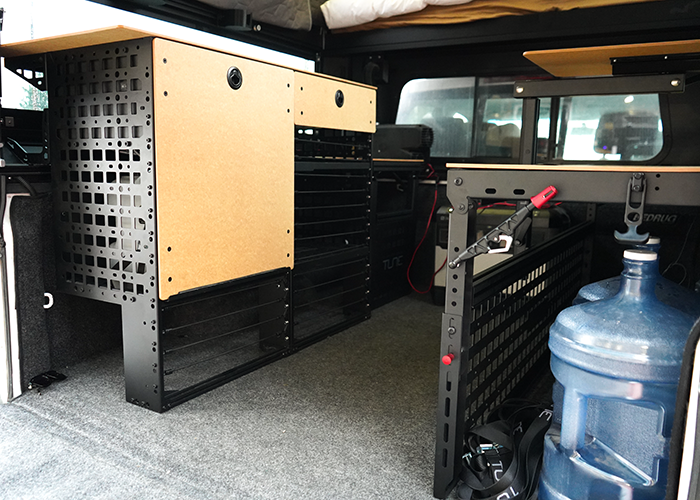
Tune campers are customizable, so you can build your setup around what you actually need. That extends to Tune’s modular interior system, which lets you choose individual components rather than committing to a heavy, fixed interior.
Aerodynamics Matter, Too
Weight isn't the only factor affecting MPG. At highway speeds, aerodynamic drag becomes increasingly important.
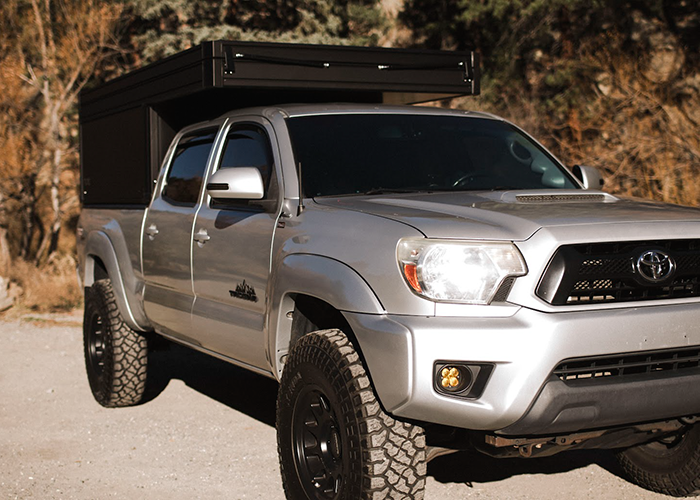
Adding a camper changes the shape of your truck and how air moves around it. A taller camper changes the way air moves over the truck and can create more resistance, especially at higher speeds.
Speed makes this effect more noticeable. Aerodynamic drag increases rapidly as speed increases, so driving at 70 mph can use significantly more fuel than driving at 60 mph.
Truck size also affects how much a camper impacts fuel economy. The same camper makes up a larger portion of the overall weight on a smaller, lighter truck than it does on a larger, heavier truck. Because of this, the added weight of the camper may have a greater relative impact on a smaller truck.
A smaller truck, however, may have less aerodynamic resistance because there is less vehicle for the air to move around. In other words, a larger truck may have an advantage when it comes to handling the camper's weight, while a smaller truck may have an aerodynamic advantage. The overall effect depends on the specific truck and camper combination.
Real-world examples from midsize trucks show that the change can be relatively modest.
- One 2024 Tacoma Hybrid owner reported going from 21–22 MPG to 18–20 MPG, a decrease of roughly 2–3 MPG after adding a Tune M1.
- A 2024 Ford Ranger owner reported a similar 3 MPG decrease, from 21 MPG to 18 MPG.
- A F150 Raptor owner reported a 1.3 MPG decrease after having his Tune M1 installed, with a new average of 11.7 MPG.
Other conditions can produce a larger difference. One Tune owner reported 22.9 MPG without the camper and 16.4 MPG with it on a highway trip. The same owner noted that fuel economy improved when they were no longer on the highway, illustrating how high speeds can further affect fuel consumption.
These examples aren't a guarantee of what you'll see with a particular truck. They show why fuel economy can vary significantly from one truck and driving situation to another.
Want to read a Tune M1L owner's experience with gas mileage on his Toyota Tacoma? Check out this blog where he tracked his MPG before and after installation.
What About Accessories and Fairings?
Accessories can affect fuel economy, too. Roof racks, bikes, storage boxes, awnings, and other equipment add weight and can disrupt airflow. Their impact depends on their size, shape, and position.
A fairing can potentially reduce aerodynamic drag by helping air transition more smoothly from the truck cab to the camper. If you add one, it’s best to mount it to the truck rather than the camper, since the Tune is designed to flex independently from the truck. Effectiveness will still depend on the specific truck, camper height, fairing design, and driving conditions, so there isn’t a universal MPG improvement to expect.
Simple Ways to Improve Fuel Economy
While you can't eliminate the impact of carrying a camper, a few habits can help:
- Keep your speed down. Aerodynamic drag increases rapidly at higher speeds.
- Maintain proper tire pressure. Underinflated tires increase rolling resistance.
- Pack intentionally. Every additional pound contributes to total vehicle weight.
- Remove unnecessary gear. Exterior accessories can add both weight and aerodynamic drag.
- Accelerate smoothly. Hard acceleration uses more fuel.
- Keep your truck maintained. Proper tires, alignment, and regular maintenance help maintain fuel efficiency.
Fuel Costs vs. Hotel Costs
Carrying a camper will generally increase fuel consumption, but that doesn't necessarily mean your trips will cost more overall.
If you're using your camper instead of staying in hotels, you can weigh the additional fuel cost against what you would have spent on a room.
How much you save will depend on the trip. Longer drives will use more fuel, while shorter trips close to home may have a much smaller fuel impact. Camping fees, fuel prices, and the cost of lodging in your destination will also affect the comparison.
The point isn't that a truck camper will always be cheaper than a hotel. It's that fuel economy is only one part of the total cost of traveling with a camper.

The Bottom Line
A truck camper affects fuel economy through both weight and aerodynamics.
A lightweight camper helps minimize the impact of additional payload, while camper shape, accessories, speed, wind, and truck configuration all influence fuel economy.
There isn't a single MPG number for every truck and camper combination. The best way to understand your setup is to compare fuel economy before and after installation under similar driving conditions.
Build your Camper
FAQs
How much does a truck camper affect fuel economy?
Adding a truck camper will generally affect gas mileage, but the amount depends on your truck, driving habits, terrain, camper weight, and aerodynamics. Lightweight truck campers typically have a smaller fuel-economy impact than heavier campers.
Does a pop-up truck camper get better gas mileage than a hard-sided camper?
Pop-up truck campers are typically lighter than comparable hard-sided campers, which can reduce the fuel-economy impact of carrying additional weight. Exact MPG depends on several factors, including your truck, driving conditions, and how your camper is equipped.
How can I improve gas mileage with a truck camper?
Keeping your speed down, maintaining proper tire pressure, packing only the gear you need, minimizing unnecessary exterior accessories, and choosing a lightweight camper can all help maximize fuel economy.
Does a fairing improve gas mileage?
A properly designed fairing can potentially reduce aerodynamic drag, but the effect depends on the truck, camper, fairing design, and driving conditions.

%20thumbnail.avif)